


Hidden Salisbury - Brutalist Bridges and Wyndham Whimsies

Updated: Feb 6

Salisbury doesn’t exactly meet the criteria for Hidden Wiltshire, and yet there are a number of pockets around the city that few visitors are aware of. These areas can contain unexpected hidden gems and history. So in this blog, I would like to introduce you to one such location and why, at the time of writing, getting to it by foot is on the minds of local residents.
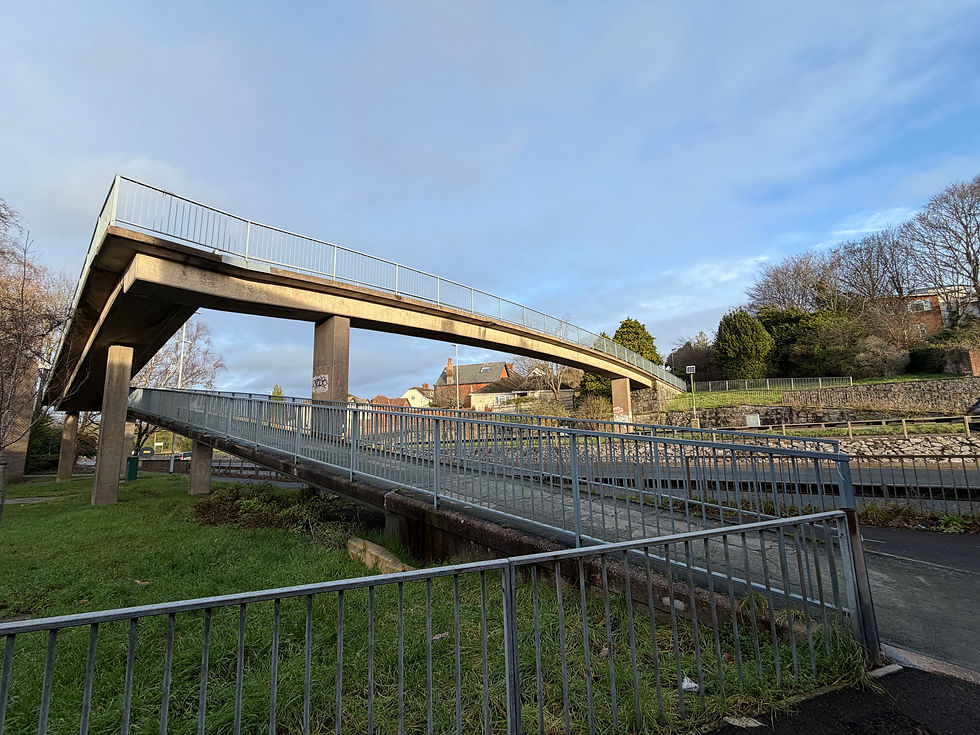
The saying that “You don’t know what you have got ’til it is gone” is, I think, apt for this blog on a number of aspects. However, I never thought that I would be applying it to the lamenting of the demise of a piece of brutalist architecture, especially one in the Salisbury landscape. And yet that is exactly what I am about to do, as Salisbury will be losing its two 1970s-built concrete and metal footbridges. These span the ring road and allow those of us who live north of the unbelievable monstrosity of the road easy accessibility to the city centre. They also give children a quick, safe route to school. Now we hear that one of the bridges, used every day by adults and schoolchildren alike, is not planned on being replaced. This is something that is counterintuitive to the council’s desire to get us all active and walking by offering safer and greater accessibility to the city and fills me with incredulity, not to mention the utter sadness at the loss.
So, the other day we decided to walk into Salisbury, as we have done on many occasions, via the doomed bridge and explore the lesser known area south of this overpass that was the city’s largest parish.

This area, the parish of St Edmund, with its church and former associated college, was established in the 13th-15th centuries. The reasons for its addition to the city were to house the increasing population and an aspiration for it to become the first university city in the country (other universities had been established before, but they were not in a city). The church is said to have once been a large, magnificent building with a steeple and a college for the training of 13 priests. However, it seems it was always a struggle to maintain. The university didn’t materialise, and in the 16th century the college was dissolved and the land was seized by Henry VIII. The church remained as a parish church bought by the parishioners, but they found it increasingly difficult to keep the church in good order. By 1613 the building no longer had a steeple, and the tower itself had become unstable. Then on Sunday, 26th June 1653, the tower began to swing wildly as the bells were rung to call the faithful to prayer. Those entering the church put their faith in God that they would be safe in the building. Miraculously, they were saved, as the tower remained upright until the parishioners had all left, and it collapsed completely the following day. The tower was quickly rebuilt along with a memorial to this event. The inscription on it shows the date in Roman numerals of the year it collapsed.

But the church’s story doesn’t end there. Centuries later, the 1960s brought the building of the ring road and the compulsory purchase of many of the parishioners' houses. As the congregation diminished, so did the requirement for it to remain a church, and so, in 1974, it was declared redundant, allowing it to become Salisbury’s Art Centre in 1975. I have enjoyed many visits to the Art Centre, but a little of me yearns to know what it was like in its heyday and before the ring road existed, but you don’t know what you’ve got, or in this case could have had, until it’s gone.

Around the same time that the church tower was swaying along with the tune of its bells, a branch of the noble Wyndham family was negotiating the purchase of the area that was once the college. The Wyndham in question was Wadham Wyndham, son of John Wyndham of Orchard Wyndham in Somerset. The name “Wadham” comes from his grandmother’s maiden name, made famous by the Oxford college that was founded by her brother and where Wadham Wyndham was educated. The fact that any of this line of the Wyndham’s exists is pretty much down to a miracle. The story goes that Wadham’s previously mentioned grandmother was thought to have died whilst pregnant with Wadham’s father. They had gone as far as placing her seemingly lifeless body in a coffin and taken it to the local church for burial the next day. However, the night before the burial, a sexton had opened the coffin to cut a ring from her finger. In doing this act, the poor woman was awakened from her catatonic state, and she cried out. Understandably, the sexton fled, leaving her to make her way home to no doubt a shocked and relieved husband. So, as a twist in this case, he was lucky to have regained what he thought was lost and gone. In due course she gave birth to Wadham’s father, John, and the start of the Wyndham dynasty. Wadham was John’s ninth son. He carved an illustrious career for himself as a judge of the king’s bench, taking part in the prosecution of the regicide of Charles I, and later was a judge at the Fire Court, which was set up after the Great Fire of London. As he had so many older siblings, he had no chance of inheriting the Somerset Estate, so he turned his attention to locations in Wiltshire. His main residence was at Norrington Manor, but he also purchased St Edmunds College, which he passed on to his second son, another Wadham Wyndham. His third son purchased Dinton manor. In time other Wyndhams would become established in the county at Clouds House, East Knoyle, but that is another story.
The Salisbury Wyndhams built a residence in what were the college grounds and set about making the 44 acres their own.

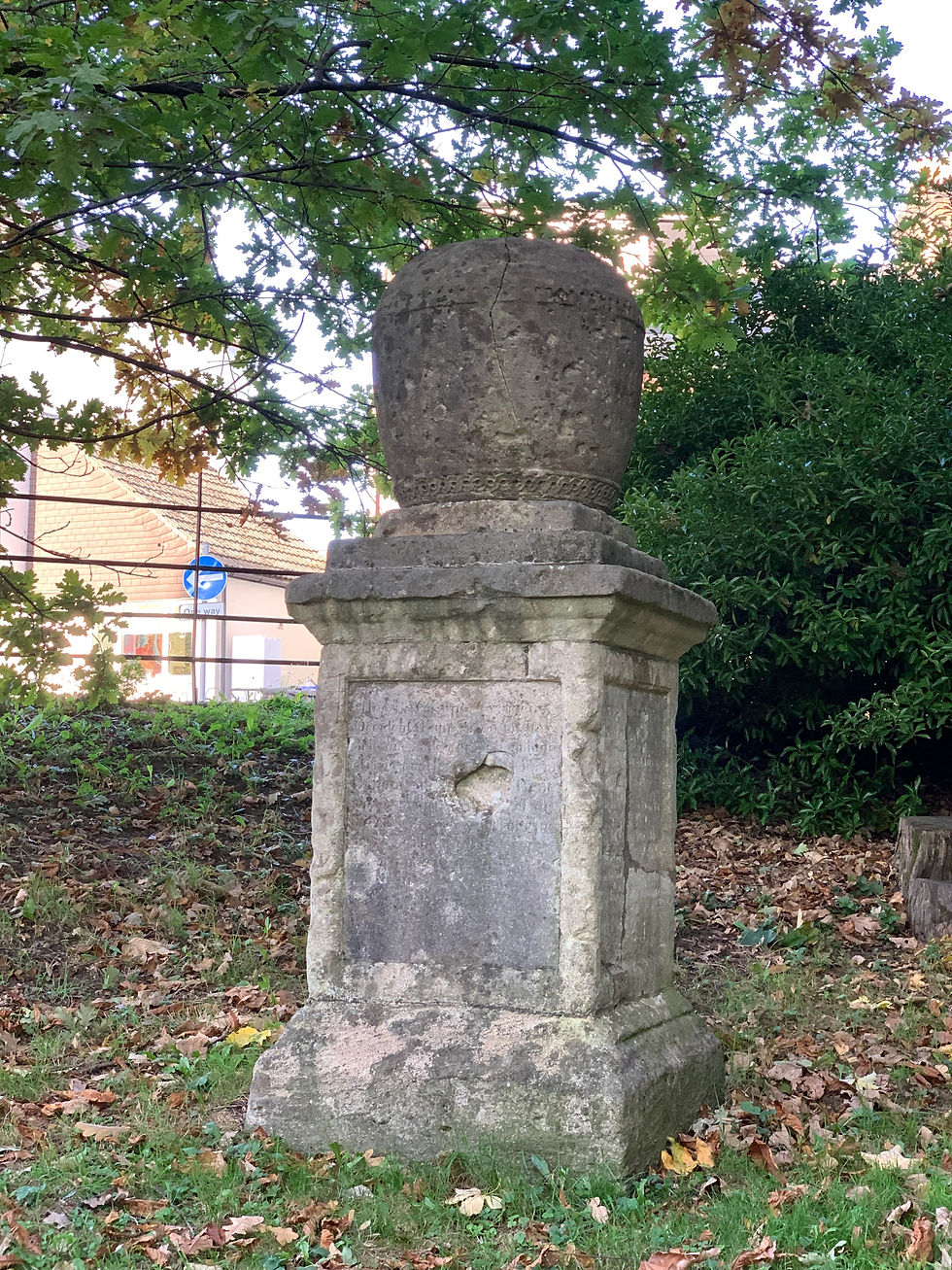
Henry Penruddock Wyndham (1736-1819) added many somewhat whimsical items to the gardens, some of which can be seen today. These include a porch from the cathedral (believed to be from the dismantled Beauchamp memorial) and an urn that depicts the location where Saxon remains were found.
Wyndham's friend, JMW Turner, painted the porch as well as St Edmund’s Church when he stayed with them (The British Museum does sell prints of both of these paintings)
All of these artefacts are still in their original location in what is now known as Bourne Hill Gardens. Visitors to the garden will notice the earthworks and steep hills. These are believed to be part of the ramparts of the old city defences and might be what is depicted in the maps produced by William Naish in the 1700s.

Many generations of the Wyndhams lived at the house they had built at St Edmunds College. Most are buried in the vault at St Edmunds Church. Sadly, it hasn’t been possible for us to locate this vault, and all but one tomb outside the former church are difficult to read. However, one grave does have a later inscription showing that it is the burial place of Henry Hatcher (1777-1846), the historian who wrote the Salisbury section of Colt Hoare’s History of Wiltshire. It is thought that he was never fully recognised for his work and died suddenly at the age of sixty-nine, perhaps another tale of only knowing what you had when it is gone.

Other Wyndham family members have memorials in the cathedral, including a row of gravestones in the north transept and a magnificent memorial to Thomas, who served as Lord Chancellor of Ireland.

The Wyndhams eventually sold the St Edmunds College property to a builder, and some of the land was given over to housing before it was finally sold to a Mr Bourne, who gives his name to the park. Eventually the council bought the area, and it is now used by the council and the police as their Salisbury headquarters. It is a lovely area to walk, made all the more interesting by the whimsies left by the Wyndhams. If you do visit of an evening, you can always call into the Wyndham Arms pub and toast (or not) the family from which the pub takes its name with a glass of one of their Hop Back Brewery specials.

I hope you have enjoyed this blog. I am sure there are many aspects I have missed out, but hopefully it gives you a hidden insight into this area of Salisbury and will tempt you away from the usual locations just follow the directions for the Arts Centre.
Footnote:
January 2026: The fact that the footbridge isn't planned on being replaced is a loss to the residents of Salisbury. Once again it shows that walkers and the community are not considered during these multimillion pound developments. There is a campaign to get the bridge replaced.


John Turner? or Joseph?(/William/JMW)